Wrap Coverage Calculator: Estimating Panels and Budget Without Guessing


Ready to stop guessing and start making smart choices? A wrap coverage calculator gives you real numbers for your car buying plans. You can see exactly how many panels you need and what your budget looks like. This helps you avoid surprises and keeps your car buying costs under control. If you want a car buying negotiation strategy that works, use real data to Negotiate a Wrap Quote. You get to save money and keep print quality high. Take charge and make sure you get the best deal.












Key Takeaways
-
Use a wrap coverage calculator to get correct panel and budget numbers.
-
Measure your vehicle with care so you enter the right sizes in the calculator.
-
Check the calculator results to see how much vinyl you need and what it will cost.
-
Pick a full wrap or a partial wrap to manage costs and still make your vehicle look good.
-
Include custom parts like spoilers or roof racks, since they can change your wrap estimate.
-
Watch out for mistakes like not counting enough panels or forgetting about installation fees.
-
Get your data ready before you ask for a wrap quote to show you know what you are doing.
-
Think about doing your wrap in steps or using simple designs to save money but keep good quality.
Using a Wrap Coverage Calculator
Input Vehicle Dimensions
First, you put your car’s measurements into the wrap coverage calculator. This step is easy, but it helps you get the right numbers. Use a tape measure to find the length, width, and height of your car. For better results, measure each panel like the doors, hood, roof, and bumpers. The calculator uses these numbers to tell you how much vinyl you need.
Here’s what the calculator does with your data:
-
Measure your car’s length and width to find the surface area.
-
Enter the height and width for each panel to get square footage.
-
Add up the square footage for all panels, including bumpers and roof.
-
The calculator rounds up the total so you have enough material.
-
It adds extra vinyl for overlap and waste, usually about 10%.
Tip: Check your measurements twice. Wrong numbers can waste material or leave spots uncovered. If you need help, many calculator tools (like those on PP, CD, or BLOG) have guides or templates for measuring.
Review Calculator Results
After you enter your car’s size, the calculator shows you how many panels and how much vinyl you need. You’ll see numbers for each part of your car and a total coverage estimate. This helps you plan your wrap and budget.
Look for these details in your results:
-
Total square footage for all panels
-
Amount of vinyl needed based on roll size
-
Extra material for overlap and waste
-
Estimated cost for materials
Note: Some calculators also show installation fees and prep costs. If yours doesn’t, check resources like OTHER for budgeting tips.
Mistakes can happen if you read the results wrong. Watch out for these common problems:
-
Underestimating design complexity
-
Choosing the wrong vinyl type
-
Ignoring installation or prep fees
-
Overlooking special features like spoilers or roof racks
-
Not counting material waste
If you see any of these mistakes, fix your inputs and check the results again. This step helps you avoid surprises and keeps your budget safe.
Select Full or Partial Wrap
Now you pick if you want a full wrap or a partial wrap. The calculator lets you choose which panels to cover, so you can see how your choices change the cost.
Full wraps cover almost every painted surface. They give you full visibility and protect your paint. Partial wraps cover important areas like side panels, rear doors, or the hood. You can save money by wrapping only the parts that matter most for style or branding.
Here’s a quick comparison:
|
Wrap Type |
Coverage |
|
|---|---|---|
|
Full Wrap |
$2,500 – $7,000 |
Almost every painted surface |
|
Partial Wrap |
$600 – $3,000 |
Areas like side panels and rear doors |
Partial wraps can cut costs by 30–50% and still look great. If you want to save money, start with a partial wrap and add more later.
Pro Tip: Use the calculator to try different coverage options. Pick only the panels you need, then compare the cost and coverage. You’ll see how planning helps you get a better wrap quote.
Now you can use your calculator results to negotiate smartly. With correct panel counts and budget estimates, you can talk about your wrap quote and make sure you get the best deal.
Adjust for Custom Features
Sometimes your vehicle has things like spoilers or roof racks. These custom features change how you figure out wrap coverage. The wrap coverage calculator can help you see these changes, but you still need to do some things yourself. Custom parts are not the same as regular panels. You have to measure each special part. Use a tape measure to check the length, width, and height of every extra piece. Put these numbers into the calculator. This step helps you get the right panel count and budget.
Here are some things to remember:
-
Custom features like spoilers and roof racks need you to measure by hand. Regular calculators do not count them by themselves.
-
Aftermarket accessories can make your vehicle a different shape or size. You must change your panel estimates to fit.
-
Special shapes and curves mean you will need more vinyl. Wrapping these parts uses more material and takes longer.
-
Vehicles with tricky shapes need you to be careful. You might have to cut and stretch the vinyl to make it fit.
-
Curved or sunken panels are harder to wrap. Flat panels are easier, but custom features make things more difficult.
Tip: Always add a little more vinyl for custom parts. You do not want to run out while wrapping. If you are not sure, ask your wrap provider for help with measuring and planning.
When you adjust for custom features, your budget is more correct. You can see how much extra material you need and how these parts change labor costs. The calculator shows you what you need, so you can plan your wrap and talk about your quote with confidence.
If you want to spend less, you can wrap just the main panels and skip some extras. Use the calculator to see the cost for full wraps and partial wraps. This helps you control your budget and still make your car look good.
Panel Mapping and Complexity
When you use a wrap coverage calculator, you need to know how many panels your vehicle has and how complex each one is. This step helps you get a more accurate estimate for both material and labor. Let’s break down how you can map panels and factor in complexity for different vehicle types.
Count Panels by Vehicle Type
Every vehicle has a unique shape and number of panels. Counting them correctly is key for your wrap estimate. Here’s a quick guide for common vehicle types:
Coupe
A coupe usually has fewer panels. You’ll count the hood, roof, trunk, two doors, two fenders, two quarter panels, front and rear bumpers, and sometimes side skirts. That’s about 8–10 main panels.
Sedan
A sedan adds more doors and sometimes a larger trunk. You’ll count the hood, roof, trunk, four doors, two fenders, two quarter panels, front and rear bumpers, and side skirts. Expect 10–12 main panels.
SUV
SUVs have bigger bodies and more panels. You’ll count the hood, roof, trunk or hatch, four doors, two fenders, two quarter panels, front and rear bumpers, and sometimes extra panels for wheel arches or running boards. That’s 12–15 panels.
Truck
Trucks can be simple or complex. You’ll count the hood, roof, bed sides, tailgate, two doors, two fenders, front and rear bumpers, and sometimes toolboxes or bed covers. Trucks often have 10–14 panels.
Tip: Use your calculator to select which panels you want to wrap. This helps you plan for a full or partial wrap and see how your choices affect your budget.
Complexity Multipliers
Not all wraps are the same. Some materials and designs take more time and skill to install. This is where complexity multipliers come in. They adjust your cost based on how tricky the job is.
Here’s a table to show how different wrap types can change your total cost:
|
Wrap Type |
Complexity Multiplier |
|---|---|
|
Carbon Fiber Wrap |
2.0x |
|
Color Change Wrap |
1.0x |
|
Chrome Wrap |
1.8x |
|
Metallic Wrap |
1.5x |
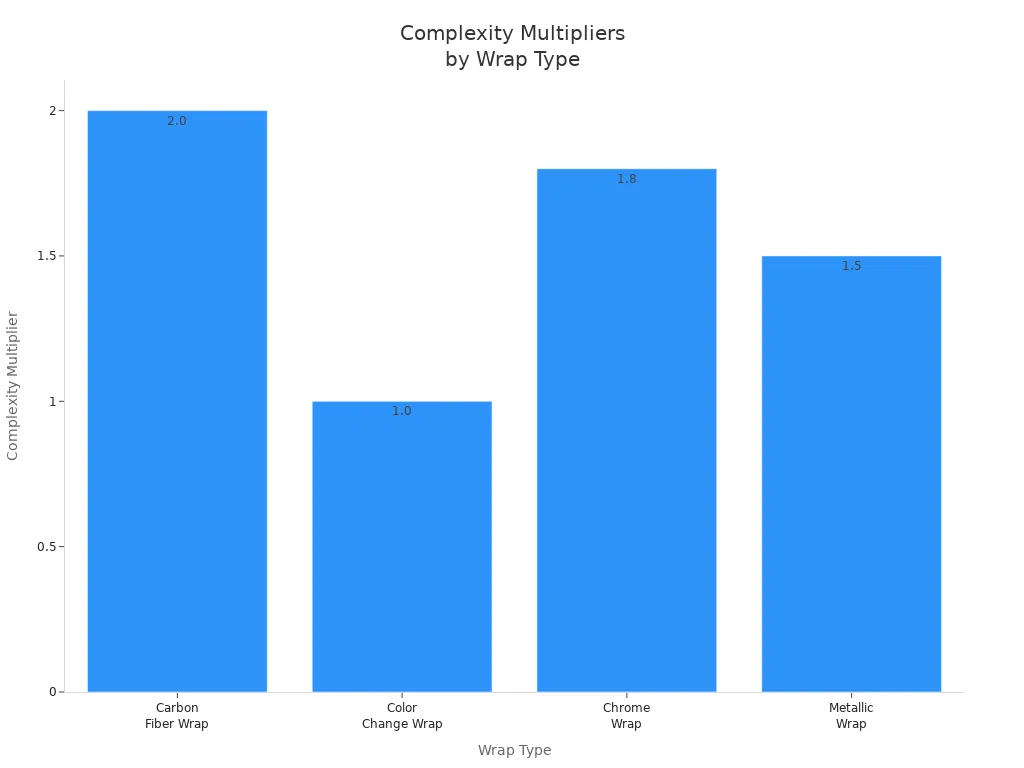
Labor also depends on design and installation. Professional installers usually cover about 12 square feet per hour. If your wrap has a high multiplier, expect more hours and a higher quote.
Curves and Accessories
Curves and accessories make wraps more challenging. Vehicles with lots of curves or extra parts need more vinyl and more time.
|
Factor |
Description |
|---|---|
|
Complex shapes increase labor time and precision required for installation. |
|
|
Accessories |
Items like bull bars or roof racks add to installation complexity and costs. |
|
Vehicle Shape |
Boxy vans are easier to wrap than curvy cars like a Beetle. |
|
Modifications |
Luxury or heavily modified vehicles cost more to wrap. |
|
Component Removal |
Some parts may need to be removed, adding labor costs. |
If your car has roof racks, spoilers, or custom bumpers, you’ll need to measure these and add them to your calculator. Curvy cars or those with lots of accessories will have higher complexity multipliers. This means more material, more labor, and a bigger budget.
By mapping your panels and understanding complexity, you can use your wrap coverage calculator to get a real estimate. This helps you plan your wrap, set your budget, and negotiate your quote with confidence.
Example Calculations

Coupe Example
Let’s walk through a coupe wrap estimate using your wrap coverage calculator. You can follow these steps to get a clear idea of how much vinyl you’ll need and what your budget might look like:
-
Measure each panel: Use a tape measure to get the length and width of every panel—doors, hood, roof, trunk, fenders, and bumpers. Write down each number in inches or centimeters.
-
Calculate surface area: Multiply the length by the width for each panel. Add up all the areas to get your coupe’s total surface area.
-
Add for overlaps and curves: Increase your total area by 5–10%. This covers extra vinyl needed for curves and to make sure you don’t run short.
-
Pick your vinyl roll width: Most vinyl comes in rolls about 1.52 meters (5 feet) wide. Your calculator will help you figure out how many rolls you need based on your total area.
Tip: Double-check your numbers before you move on. A small mistake in measuring can throw off your whole estimate.
Sedan Example
Now, let’s try a sedan. Sedans have more panels than coupes, so you’ll need to measure a few extra spots. Here’s how you can do it:
-
Measure the hood, roof, trunk, four doors, two fenders, two quarter panels, and both bumpers.
-
Add up the surface area for each panel, just like you did with the coupe.
-
Don’t forget to add 5–10% for curves and overlaps.
-
Enter your numbers into the wrap coverage calculator. It will show you the total vinyl needed and give you a budget estimate.
You’ll see that sedans usually need more vinyl than coupes. The calculator makes it easy to compare costs and see how adding or skipping panels changes your budget.
SUV Example
SUVs are bigger and have more complex shapes. This means you’ll need more vinyl and your budget will be higher. For small SUVs, a full wrap usually costs between $3,000 and $4,640. That price reflects both the amount of vinyl and the extra work needed for installation.
-
Most SUVs need 65–90 feet of vinyl for a complete wrap. Smaller models like the Honda CR-V or Toyota RAV4 use about 65–75 feet. Larger SUVs, such as the Chevrolet Tahoe or Ford Expedition, may need 75–90 feet or more.
-
The calculator helps you see how vehicle size affects your panel count and budget. Bigger SUVs mean more panels and higher costs.
Note: The more vinyl you need, the more your wrap will cost. The calculator shows you this right away, so you can plan your budget and coverage before you talk to any wrap provider.
With these examples, you can see how the wrap coverage calculator takes the guesswork out of estimating panels and budgeting. You get real numbers to help you negotiate your wrap quote with confidence.
Truck Example
Trucks bring their own challenges when you estimate wrap coverage. You deal with bigger panels, unique shapes, and sometimes extra accessories like toolboxes or bed covers. You need to use your wrap coverage calculator to get the right numbers for both material and budget.
Start by measuring each panel. Grab your tape measure and check the hood, roof, bed sides, tailgate, doors, fenders, and bumpers. If your truck has extras like a toolbox or a bed cover, measure those too. Write down the length and width for each part. Your calculator will help you add up the total surface area.
Trucks usually have more square footage than sedans or coupes. That means you need more vinyl and more labor. Here’s a quick look at how truck wrap costs compare to other vehicles:
|
Vehicle Type |
Full Wrap |
Partial Wrap |
Spot Graphics |
|---|---|---|---|
|
Pickup Truck |
$3,150–$4,370 |
$2,325–$2,600 |
$1,175–$1,300 |
|
Large Cargo Van |
$3,300–$7,115 |
$2,775–$3,675 |
$1,225–$1,700 |
|
Standard Cargo Van |
$3,025–$6,005 |
$2,500–$3,450 |
$1,125–$1,550 |
|
Compact Cargo Van |
$3,025–$5,305 |
$2,375–$2,700 |
$1,125–$1,250 |
|
SUV or Minivan |
$3,275–$4,830 |
$2,175–$2,800 |
$1,200–$1,450 |
|
Sedan or Coupe |
$2,950–$3,970 |
$2,125–$2,400 |
$1,100–$1,250 |
You can see that pickup trucks cost more to wrap than sedans or coupes. Larger vehicles need more vinyl, more labor, and careful planning to make sure the graphics line up across all panels. Wrapping a compact sedan costs less because it has less surface area.
Let’s walk through a sample calculation for a pickup truck:
-
Measure each panel: Hood, roof, bed sides, tailgate, doors, fenders, bumpers, and any accessories.
-
Add up the surface area for all panels.
-
Increase your total by 10% for curves, overlaps, and waste.
-
Enter your numbers into the wrap coverage calculator.
-
Review the calculator’s estimate for vinyl rolls and budget.
Tip: Use a worksheet or planner to track your measurements. Write down each panel’s size and check your math. This helps you avoid mistakes and keeps your budget on target.
If you want to save money, you can choose a partial wrap. The calculator lets you select only the panels you want to cover. You might wrap just the doors and bed sides, leaving the roof and bumpers as they are. This cuts your costs and still gives your truck a fresh look.
When you use the wrap coverage calculator, you get real numbers for your truck wrap. You can plan your budget, compare full and partial wraps, and negotiate your quote with confidence. The calculator makes it easy to see how your choices affect the price, so you stay in control.
Common Estimating Mistakes
Underestimating Panels
Some people only count the big panels. But missing even one panel can mess up your wrap. If you do not count every panel, seams might not line up. You could see gaps in your design. This looks bad, especially with patterns or logos. Fixing these mistakes costs more time and money. You may need to take off the old vinyl and clean sticky glue. Sometimes, you even have to fix the paint. It is easier and cheaper to count all panels the first time.
When you use a wrap coverage calculator, check every panel twice. Do not forget the roof, bumpers, or small trim pieces. The calculator shows you everything, so you can plan your budget and avoid surprises.
Overlooking Complexity
Not every vehicle is the same. Some cars have flat sides, but others have curves or lots of extras. If you forget about these tricky parts, your estimate will be wrong. Here is what can happen:
-
You might pay more because your first guess was too low.
-
Extra work hours add up fast with hard shapes.
-
You may need better vinyl for tough spots, which costs more.
A wrap coverage calculator lets you add complexity multipliers. Use these tools to change your estimate for curves, spoilers, or custom parts. This way, you get a better idea of how much material and work you need.
Ignoring Accessories
It is easy to forget about things like roof racks or spoilers. These small parts can change your wrap estimate a lot. If you skip them, you might not have enough vinyl or you could pay extra later. Always measure and add every accessory to your calculator.
Industry surveys show missing details can hurt your wrap and your business. Here are some common mistakes and what they cause:
|
Mistake Description |
Impact |
|---|---|
|
Parking vehicles out of sight |
Loses hundreds of thousands of impressions annually |
|
Letting design override readability |
Fails at high speeds due to poor legibility |
|
Not training staff on professionalism |
Poor driving harms trust and accountability |
|
Zero tracking |
Underestimates ROI by 30–50% |
|
Wrong CTA or too many CTAs |
Confusing info leads to missed opportunities |
Tip: Always use your wrap coverage calculator for every panel and accessory. This helps you avoid mistakes and keeps your budget safe.
If you pay attention to these things, your estimate will be better. You can use your calculator results to talk about your wrap quote and get the most for your money.
Misreading Calculator Output
You might think the calculator does everything for you. It gives you numbers, but you must read them carefully. If you misread the calculator, you can make big mistakes. You could buy too little vinyl or pay for panels you do not need. You might also miss hidden costs. To talk about your wrap quote with confidence, you need to understand what the calculator says.
Sometimes, calculators show results in square feet, meters, or rolls of vinyl. You have to check which unit the calculator uses. If you mix up the units, your estimate will be wrong. You could order too much or not enough material. Always match the calculator’s units with what your supplier sells.
Wrap calculators usually show coverage for each panel. You see numbers for doors, hood, roof, bumpers, and extras. If you skip a panel or read the area wrong, your wrap will not fit. Double-check the size of every panel and include all the parts you want to wrap. If you want a partial wrap, pick only the panels you need. This helps you control your budget and not pay for extra material.
Sometimes, calculators add more vinyl for overlap and waste. You might see a “waste factor” or “overlap margin” in the results. Do not ignore these numbers. They help you avoid running out of vinyl during installation. If you leave them out, you might get gaps or seams that look bad.
You can follow some best practices to avoid mistakes with calculator output:
-
Estimate to Verify Answers: Try a quick estimate before you trust the calculator. If the number looks strange, check your inputs. Estimating helps you find mistakes fast.
-
Cross-Check with a Different Method: Use another calculator or ask your wrap provider for help. If both ways agree, you can trust your numbers.
-
Keep Your Work Organized: Write down each panel’s size and calculator results. An organized worksheet helps you follow your math and catch errors.
Tip: If a result does not make sense, stop and check your steps. Sometimes, a small mistake or missed panel can change your whole budget.
You can use the calculator to plan full or partial wraps. Try different options and see how the numbers change. This gives you power when you talk about your wrap quote. You know what you need and what you should pay.
If you keep your math clear and double-check your results, you avoid costly mistakes. You get the right amount of vinyl, cover every panel, and stay on budget. The wrap coverage calculator becomes your best tool for estimating panels, budgeting, and talking about your quote with confidence.
Negotiate a Wrap Quote
Prepare Your Data
Before you try to negotiate a wrap quote, you need to get your numbers ready. The wrap coverage calculator helps you with this. You already know how many panels you want to wrap and how much vinyl you need. You also know your budget for a full or partial wrap. Bring all this information when you talk to wrap shops.
Here’s what you should have ready:
-
Your vehicle’s measurements and panel count from the calculator
-
The total square footage of vinyl you need
-
A list of which panels you want wrapped (full or partial)
-
The estimated cost for materials and labor
-
Notes about any custom features or accessories
When you show up with these details, you look prepared. You can answer questions fast and show you did your homework. This makes it easier to talk about price. Shops will see you know what you want and that you are not guessing. You can use your calculator results to support your requests and ask for a better quote.
Tip: Print your calculator worksheet or save it on your phone. You can look at it during your talk and make changes if you need to.
Market Research for Negotiation
You should not go into a negotiation without knowing what other shops charge. Take some time to call or check websites for wrap quotes in your area. Write down prices for similar vehicles and wrap types. This gives you a price range and helps you find a fair deal.
Market research also gives you power. If you find a shop with a lower price for the same quality, you can use that when you negotiate a wrap quote. Some shops may match or beat a competitor’s price if you show proof.
You can also use your research to find discounts. For example, if you want to wrap more than one vehicle or use different types of vinyl, you can ask for a volume discount. Here’s a table to show how this works:
|
Strategy |
Description |
Potential Savings |
|---|---|---|
|
Leverage Volume for Discounts |
Buy more vinyl at once to get a better deal. |
Aim for a 15% discount on the $420 material by committing to annual volume, saving $63 per wrap. |
When you know the market, you can negotiate with confidence. You can ask for discounts, compare offers, and avoid paying too much. This step makes talking about price less stressful and helps you get the best value.
Negotiating tips: Always ask if there are seasonal deals or package offers. Sometimes, shops have special deals that are not online.
Making a Counteroffer
Now you are ready to make your move. When you get a quote, do not take the first number. Use your calculator data and market research to make a strong counteroffer. Here are some strategies that work well when negotiating:
-
Do good market research to know the vehicle’s value and make smart counteroffers.
-
Decide what you can give up first during talks.
-
Be patient so you have more control and do not rush.
-
Show you are ready to make a deal but be willing to walk away if you do not like the terms.
Let’s say the shop gives you a quote that is higher than your budget. You can point to your calculator results and say, “Based on my panel count and the amount of vinyl needed, I think this quote is a bit high. Can you do better?” If you found a lower price somewhere else, mention it. You might say, “Another shop quoted me $400 less for the same coverage. Can you match that?”
If the shop cannot lower the price, try asking for extras. Maybe they can add a better laminate, a longer warranty, or free prep work. Sometimes, it is not just about the lowest price but about getting more for your money.
Tip: Stay calm and friendly. If you feel rushed or pressured, take a break. You can walk away if the quote does not fit your needs.
Negotiating a wrap quote is not just about saving money. It is about making sure you get the right coverage, quality, and service for your money. Use your calculator, do your research, and do not be afraid to make a counteroffer. You will feel more confident and in control every step of the way.
Walk-Away Point
You have your numbers. You know your panels, your coverage, and your budget. You used the wrap coverage calculator to get real data. Now, you need to decide when to walk away from a wrap quote.
Walking away sounds tough, but it gives you power. You do not have to accept a deal that does not fit your needs. If the shop will not meet your price or quality standards, you can leave. Sometimes, walking away leads to better offers. Other times, it shows you that the deal is not right for you.
Here’s how you can set your walk-away point:
-
Know all the numbers
Check your total cost. Make sure you include every fee—materials, labor, prep, and extras. The calculator helps you see the real price. If the quote is higher than your budget, you can say no. -
Consider other negotiable items
If the shop will not lower the price, look for other things to negotiate. Ask about better laminate, longer warranty, or free prep steps. You can also ask for a phased plan or simpler design to cut costs without losing quality. -
Don’t be afraid to walk away
You control the negotiation. If you do not get a fair deal, you can leave. Shops may come back with a better offer. If not, you can find another provider who fits your needs.
Tip: Write down your walk-away point before you start negotiating. If the quote goes above your number or the shop will not add value, you know it is time to leave.
You can use your calculator results to back up your decision. If the shop tries to charge more than your estimate, show your panel count and coverage plan. This proves you did your homework and helps you stand firm.
Walking away is not a failure. It is a smart move. You protect your budget and make sure you get the wrap you want. The wrap coverage calculator gives you the confidence to say yes or no. You stay in control and get the best deal for your vehicle.
Reduce Wrap Cost, Keep Quality
Cut Scope, Not Quality
You want to save money on your vehicle wrap, but you don’t want to lose quality. The best way to do this is to cut scope, not quality. Instead of wrapping every panel, you can use your wrap coverage calculator to pick the panels that matter most. Maybe you only need the doors and hood wrapped for branding. You can leave the roof and bumpers as they are. This approach helps you control your budget and still get a professional look.
When you focus on scope, you keep the quality high. Cheap wraps might save you money upfront, but they don’t last long. Quality wraps stay looking good for years and cost less over time. Take a look at this table:
|
Type of Wrap |
Lifespan |
Maintenance Cost |
|---|---|---|
|
Cheap Wrap |
1-2 years |
Higher long-term cost |
|
Quality Wrap |
5-7 years |
Better value over time |
You can also make sure your wrap looks polished by following these steps:
-
Stretch and apply vinyl properly to avoid bubbles and wrinkles.
-
Align graphics and logos so they look seamless.
-
Make sure the vinyl sticks smoothly to prevent peeling.
Tip: Use your calculator to compare partial and full wraps. You’ll see how changing scope affects your budget and coverage.
Phased Plans and Simpler Designs
If your budget feels tight, you can ask your provider about phased wrap plans. This means you wrap your vehicle in stages. Start with the main panels now, then add more later when you have extra funds. Simpler designs also help you save money. You can choose a basic color or logo instead of a complex pattern. This reduces labor and material costs.
Here’s a table showing the benefits of phased plans and simpler designs:
|
Benefit |
Description |
|---|---|
|
Greater control |
Lets you decide which panels to wrap and when. |
|
Easier administration |
Makes planning and claims simpler for everyone involved. |
|
Lower costs, better safety |
Cuts costs by combining jobs and keeps quality consistent. |
|
Opportunities for small contractors |
Makes it easier for smaller shops to take on your project. |
You can also improve quality and save money by:
-
Training staff to follow these steps.
-
Scheduling jobs to use workshop time wisely.
-
Negotiating material costs for discounts.
Note: Set clear goals for your wrap project and involve the right people. This keeps your wrap looking sharp and on budget.
Confirm Laminate and Warranty
Don’t forget to ask about laminate and warranty options. Specialty coatings and laminates protect your wrap from scratches and sunlight. This keeps your wrap looking new for longer. Warranty terms tell you what the manufacturer promises about color and peeling. A good warranty means you won’t worry about your wrap fading or lifting.
-
Warranty terms cover color retention and delamination.
Tip: Always check what’s included in your wrap quote. Confirm the laminate type and warranty length before you agree to anything.
When you use your wrap coverage calculator and follow these steps, you can reduce wrap cost without losing quality. You stay in control, make smart choices, and get the best value for your money.
Prep Steps with Provider
You want your vehicle wrap to look great and last long. Before the wrap goes on, you need to work with your provider. Good prep steps help you avoid mistakes and save money. You can use your wrap coverage calculator to help talk with your provider and get the results you want.
First, share your calculator worksheet with your provider. Show your panel counts, coverage plan, and budget. This helps your provider know your goals and gives them a clear place to start. You can ask questions and get advice about your choices.
Here are some important prep steps to follow:
-
Schedule a Pre-Wrap Inspection
Ask your provider to look for dents, scratches, or old paint. Clean surfaces help vinyl stick better. If your car needs repairs, fix them before wrapping. -
Confirm Panel Selection
Use your calculator to show which panels you want wrapped. Check with your provider. Make sure you both agree on full or partial coverage. -
Discuss Material Choices
Talk about vinyl types, laminate options, and colors. Ask your provider to explain the good and bad parts of each choice. Use your calculator’s material estimate to compare costs. -
Review Design Proofs
Ask for digital pictures or printed samples. Check that logos, graphics, and colors look right. Make changes before the wrap goes on. -
Plan Installation Timing
Find out how long the wrap will take. Ask about shop hours and when you can bring your car. Make sure you can drop off and pick up your vehicle easily.
Tip: Bring your calculator worksheet to every meeting. It keeps you organized and shows you are serious about your wrap.
You can also use a checklist to stay on track:
|
Prep Step |
Why It Matters |
Action Item |
|---|---|---|
|
Pre-wrap inspection |
Stops problems with vinyl |
Schedule with provider |
|
Panel selection review |
Makes sure no spots are missed |
Confirm with calculator |
|
Material discussion |
Helps control cost and quality |
Compare options |
|
Design proof approval |
Makes sure branding is correct |
Ask for samples |
|
Installation planning |
Saves time and trouble |
Set dates |
When you follow these steps, the wrap process goes smoother. You avoid last-minute problems and keep your budget safe. Your wrap coverage calculator helps you stay in control. You can talk about your quote, plan your coverage, and get the quality you want.
Note: If you are not sure about any step, ask your provider for help. A good provider will answer your questions and help you make smart choices.
You can use your calculator and prep checklist to guide every talk. This gives you confidence and helps you get the best wrap for your money.
Negotiation Checklist
You want to feel ready for your wrap quote talk. This checklist helps you stay organized and confident. Use your wrap coverage calculator results as your main tool. You can use the worksheet below to track your info and compare quotes.
Info to Bring
Before you meet a wrap provider, gather these details:
-
Your vehicle’s measurements and panel counts from the wrap coverage calculator
-
Surface area totals for each panel
-
List of panels you want wrapped (full or partial)
-
Budget estimate for materials and labor
-
Notes about custom features or accessories
-
Complexity multipliers for tricky panels
-
Printout or digital copy of your calculator worksheet
Tip: Bring your worksheet and calculator results. Providers see you are prepared and take your negotiation seriously.
Negotiation Worksheet Example:
|
Panel Name |
Area (sq ft) |
Complexity |
Wrap Type |
Estimated Cost |
|---|---|---|---|---|
|
Hood |
20 |
Standard |
Partial |
$150 |
|
Roof |
25 |
Curved |
Full |
$200 |
|
Doors (each) |
18 |
Standard |
Partial |
$120 |
|
Bumpers |
15 |
Complex |
Full |
$180 |
|
Accessories |
10 |
Custom |
Partial |
$90 |
You can fill in your own numbers. Use this worksheet to guide your negotiation.
Questions to Ask
Asking smart questions helps you get the best deal. Here are some you should ask:
-
What vinyl brands do you use?
-
Is laminate included in the quote?
-
How long does the warranty last?
-
Can you show me design proofs before installation?
-
What prep steps do you recommend?
-
Are there extra fees for accessories or complex panels?
-
Can you offer phased wrap plans or simpler designs to reduce cost?
Note: Write down answers. Compare them with your calculator worksheet and budget.
Compare Quotes
Always compare quotes from different providers. Use your calculator worksheet to check if each quote matches your panel counts and coverage plan.
Comparison Table Example:
|
Provider |
Total Cost |
Panels Covered |
Laminate |
Warranty |
Extras Included |
|---|---|---|---|---|---|
|
Shop A |
$3,200 |
Full |
Yes |
5 years |
Prep, Design |
|
Shop B |
$2,800 |
Partial |
Yes |
3 years |
Prep |
|
Shop C |
$3,000 |
Full |
No |
2 years |
None |
Look for differences in coverage, quality, and extras. If a quote seems high, use your calculator results to ask for a better deal.
Checklist:
-
Bring your calculator worksheet
-
Ask key questions
-
Compare quotes side by side
-
Check for laminate and warranty
-
Confirm panel counts and coverage
-
Set your walk-away point
You can use your wrap coverage calculator and this checklist to negotiate with confidence. You stay in control and get the best value for your vehicle wrap.
You can use the wrap cost calculator to estimate panels and plan your budget. This tool helps you spot a good deal and avoid paying more than a good price. When you follow the checklist, you see how to get a good deal on every panel. You can compare quotes and ask for a good deal from your provider. If you want a good deal, use your calculator and scripts. Start estimating now and negotiate for a good price. You will get a good deal and feel confident every step.
FAQ
How does a wrap coverage calculator help me save money?
You get real numbers for your panels and budget. This lets you see where you can cut costs or choose a partial wrap. You avoid guessing and can talk to providers with confidence.
Can I use the calculator for any vehicle type?
Yes! You can use the calculator for cars, trucks, SUVs, and vans. Just enter your vehicle’s measurements and pick the panels you want to wrap.
What if my car has custom features or accessories?
You should measure each custom part, like spoilers or roof racks. Add those numbers to the calculator. This way, you get a more accurate estimate and avoid surprises.
Is a partial wrap a good way to lower my budget?
Absolutely! A partial wrap covers only the most important panels. You save money and still get a fresh look. The calculator shows you how much you can save.
How do I know if my calculator results are correct?
Double-check your measurements. Make sure you include every panel and accessory. If something looks off, try a quick estimate or ask your provider for help.
What should I bring when I negotiate a wrap quote?
Bring your calculator worksheet, panel counts, and budget estimate. List any custom features. This shows you did your homework and helps you get a better deal.
Can I change my wrap plan after seeing the calculator results?
Yes, you can! Try different coverage options in the calculator. You can switch from full to partial wrap or adjust which panels you want. This helps you stay on budget.